
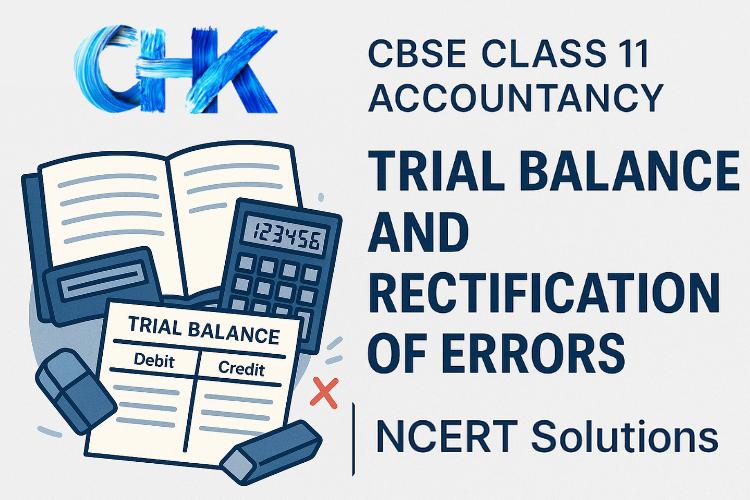
Chapter 8 Trial Balance and Rectification of Errors NCERT Solutions | CBSE Class 11 Accountancy
Chapter 8 Trial Balance and Rectification of Errors NCERT Solutions: A great resource for studying for the CBSE Class 11 Accountancy exams is NCERT Solutions. The NCERT solutions are helpful for quickly understanding the topics. This is one of the most essential parts of the syllabus. Whether you’re preparing for exams or trying to strengthen your basics, understanding this chapter is crucial for accuracy in financial reporting.
Chapter Overview: Trial Balance and Rectification of Errors
🔹 What is a Trial Balance?
A Trial Balance is a statement prepared at the end of an accounting period that lists the balances of all ledger accounts. It is used to ensure the mathematical accuracy of the books of accounts. The total of debit balances should always equal the total of credit balances.
🔹 Objectives of Trial Balance:
- To check arithmetical accuracy of ledger accounts
- To serve as the base for preparing financial statements
- To help identify errors, if any, in accounting entries
🔹 Types of Errors in Accounting
Not all errors can be detected by the trial balance. The errors are broadly classified into:
- Errors of Omission – When a transaction is completely or partially omitted.
- Errors of Commission – When an entry is recorded incorrectly.
- Errors of Principle – When the accounting principle is violated.
- Compensating Errors – When two or more errors nullify each other.
- Errors of Duplication – When an entry is recorded more than once.
🔹 Rectification of Errors
Errors can be corrected either:
- Before the preparation of trial balance (journal entries are rectified)
- After the preparation of trial balance (through Suspense Account)
Proper rectification ensures that the financial statements present a true and fair view of the business.



Why NCERT Solutions Are Important?
- Prepared by subject experts as per the latest CBSE syllabus.
- Helps students develop a conceptual understanding.
- Improves accuracy and presentation skills for exams.
- Provides step-by-step solutions for all textbook questions.
- Boosts confidence in tackling board exam-style questions.
Download Chapter 8 Trial Balance and Rectification of Errors NCERT Solutions PDF Free
To make your preparation even easier, we’re offering a free downloadable PDF of the Class 11 Accountancy Chapter 8: Trial Balance and Rectification of Errors NCERT Solutions.

Click Here To Download Chapter 8 Trial Balance and Rectification of Errors NCERT Solutions PDF
Tips to Master Chapter 8
- Understand the concept of trial balance thoroughly.
- Practice identifying and classifying errors.
- Work on multiple examples to strengthen your rectification techniques.
- Revise journal entries and ledger posting.
- Solve NCERT exercises regularly.
Also Download – CBSE Class 11 Accountancy Chapter 7 Accounting for Bills of Exchange NCERT Solutions PDF
Conclusion
Mastering Chapter 8 of Class 11 Accountancy sets the foundation for accounting efficiency. With a solid understanding of trial balance and error correction, you’ll be better prepared to tackle real-world accounting tasks and advanced concepts in class 12.
FAQs
Q1. What is the purpose of a Trial Balance in accounting?
A Trial Balance ensures that total debits equal total credits in the ledger, helping to check the arithmetical accuracy of accounts.
Q2. Are NCERT solutions helpful for board exam preparation?
Yes, NCERT solutions clarify concepts, provide accurate answers, and are aligned with the CBSE syllabus, making them ideal for exam prep.
Q3. Can all accounting errors be located using a Trial Balance?
No, a Trial Balance cannot detect errors of omission, commission, or principle if equal debits and credits are made.
Q4. How many types of errors are covered in Chapter 8 of Class 11 Accountancy?
The chapter discusses errors of omission, commission, principle, and compensating errors along with their rectification methods.
for more information contact us –
Ph. No. – +91-6367885579
WhatsApp – Click to chat
facebook – @commercehubkota
Instagram – @comerc_classes
Youtube – @commercehubkota
Telegram – @comerc.in