
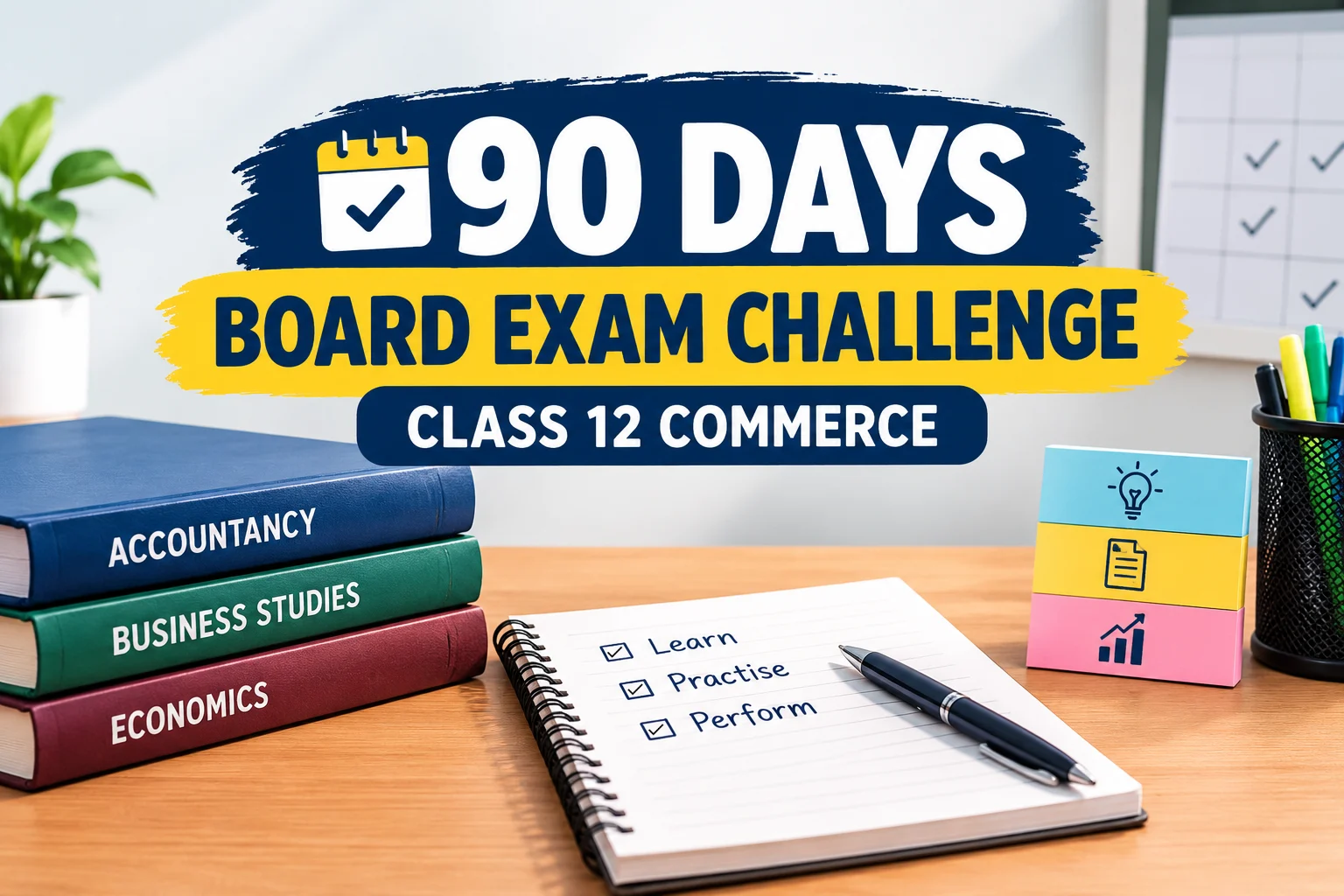



The 90-Day Board Exam Challenge: From Zero to Board-Ready
Ninety days is enough to go from “I have not studied properly” to confidently finishing the Class 12 Commerce syllabus—if you follow a strict plan of learning, revision, previous-year questions (PYQs), and mock tests. The core subjects—Accountancy, Business Studies, and Economics—each carry 80 theory marks plus 20 marks for project/internal assessment, so your plan must balance concepts, writing practice, and exam technique.
The 90-Day Board Exam Challenge Structure
| Phase | Days | Main goal |
|---|---|---|
| Foundation | 1–45 | Complete the full syllabus from zero, chapter by chapter |
| Revision + PYQs | 46–70 | Revise every subject and solve topic-wise PYQs |
| Mock-test mode | 71–90 | Full-length papers, error analysis, final revision |
CBSE’s Commerce syllabus is substantial: Accountancy includes partnership firms, company accounts, financial statement analysis, and cash flow; Business Studies covers management principles and business finance/marketing; Economics includes microeconomics and macroeconomics. Treat these 90 days like a job: fixed study hours, daily targets, and weekly performance reviews.
Phase 1 (Days 1-45): Build the base
Daily rhythm that works for most students:
- Morning (2.5-3 hrs): Your heaviest subject, usually Accountancy or Economics
- Afternoon/Evening (2.5 hrs): Business Studies, then your fourth subject
- Night (1 hr): English, plus a 20-minute recap of the day
Six to seven focused hours is enough. Ten hours of scrolling-while-studying is worse than five hours of real work.
Subject by Subject:
Accountancy: You can’t read your way through this one. Watch or read a concept, then do the questions immediately. Do all the textbook problems for partnership, then company accounts, then cash flow and ratios. Don’t skip the “easy” sums. Speed here comes from repetition. Keep a small notebook of formats (journal, ledger, balance sheet, cash flow) so you stop making silly layout mistakes.
Business Studies: This is a theory-and-language subject. Don’t mug up whole pages. For each chapter, make a one-page sheet with the definition, features, importance, and 2-3 real examples. Case-study questions reward the exact keywords from the textbook, so underline them as you read.
Economics: Split it into two buckets: Macro and Indian Economic Development (or Micro, depending on your syllabus year). Draw every diagram yourself, at least three times. Numericals like national income and multipliers need daily practice, even if it’s only five sums.
English: Don’t leave it for the last week. Write one letter, notice, or article every two days, and read one chapter of your literature text daily. It’s the subject people lose easy marks in just because they never practiced.
Maths / Informatics Practices / whichever you chose: Treat it like Accountancy: practice first, theory second.
Rule for Phase 1: after each chapter, close the book and write down everything you remember in 5 minutes. The gaps you find are exactly what to revise later.
Phase 2 (Days 46-70): Revise and attack PYQs
By now you should have seen the whole syllabus once. Now you go through it again, faster and more deliberately.
Revision method
- Use the 1-3-7 rule: revisit a topic one day, three days, and seven days after you studied it.
- Revise from your notes and one-pagers, not the textbook again.
- Say things out loud. If you can’t explain it to an imaginary friend, you don’t know it yet.
How to use Previous Year Question Papers properly
Most people just solve a paper and glance at the score. That wastes it.
- Solve one paper per subject, with the timer. Start with the most recent CBSE papers, then go backward.
- Check your answers against the marking scheme. Notice how answers are structured for 3, 4 and 6 marks.
- Keep a “mistake log” with three columns: question, what went wrong, the fix. The reasons are usually silly: a missing format, a forgotten adjustment, or not enough points for the marks.
- Spot patterns. Some topics show up almost every year. Mark those as most important or high priority.
Aim for 8-10 years of papers per subject if you can. Less is fine if you analyze them well.
You can download PYQs from below given links:
Phase 3 (Days 71-90): Mocks and polishing
The final 20 days focus on converting your preparation into exam performance.
Days 71–80: Mock tests and mistake correction
- Start attempting timed sample papers and mock tests.
- Follow the examination duration and paper pattern prescribed by your board.
- Check your answers and record the marks obtained.
- Identify conceptual errors, calculation mistakes, and incomplete answers.
- Revise weak chapters based on your test results.
- Reattempt questions you could not solve independently.
Days 81–90: Final revision and exam readiness
- Revise short notes, formulas, definitions, accounting formats, and diagrams.
- Revisit important concepts from every subject.
- Practise selected questions from weak chapters.
- Attempt additional timed papers where appropriate.
- Review mistakes from earlier tests.
- Avoid starting unnecessary new resources at the last minute.
Do not judge your preparation by one mock-test score alone. Use your performance across tests to understand your progress and what still needs attention.
Goal by Day 90: Complete the planned preparation, revise key concepts, improve your ability to solve questions independently, and become more familiar with the demands of the board examination.
How to Follow the Challenge Every Day
A 90-day plan works best when every day has a clear purpose. You can divide your available study time into four activities:
- Concept learning: Study a new chapter or topic.
- Question practice: Solve questions related to what you studied.
- Subject rotation: Give attention to the other Commerce subjects.
- Daily review: Revisit previous topics and correct mistakes.
As a general rule, avoid spending the entire day watching lectures or reading notes. Reserve time to solve questions on your own, because independent practice reveals whether you have actually understood a concept.
Review your progress every seven days. If a chapter takes longer than expected, adjust your schedule while protecting time for PYQs, mock tests, and final revision.
Can You Really Prepare from Zero in 90 Days?
Your progress will depend on the size of your syllabus, the time you can study each day, your existing understanding, and the consistency of your practice.
Starting from zero does not mean skipping the basics or relying on predicted questions. It means prioritising the prescribed syllabus, learning concepts efficiently, practising questions as you go, and correcting mistakes without wasting time.
If you have not started yet, begin by listing every chapter in your syllabus. Divide the chapters across the learning phase, schedule question practice after each chapter, and reserve the final part of your plan for mock tests and revision.
Remember: The objective is not simply to finish 90 days of studying. It is to reach the examination having learnt the syllabus, practised questions, revised important concepts, and understood your mistakes.
Habits that quietly decide the result
- Sleep 7 hours. Memory gets consolidated at night. Skipping sleep means you lose what you studied.
- Phone away during study blocks. Put it in another room, not just on silent.
- One day off per week, or at least a half day. Burnout around day 50 is common and avoidable.
- Track daily. Even a simple tick-box on paper helps. Seeing 40 ticks in a row is oddly motivating.
- Don’t compare your progress with classmates. Their plan isn’t your plan.
A quick weekly checkpoint
Every Sunday, ask yourself three questions:
- Did I finish what I planned this week?
- Which chapter still scares me?
- What’s one thing I’ll change next week?
Adjust and keep going. A plan that bends is better than one that breaks.
Final thoughts
The 90-day challenge isn’t about being perfect. You’ll have bad days, skipped schedules, and a mock test that makes you want to cry. That’s normal. What matters is that you show up the next morning and keep going.
Ninety days from now, you’ll either be glad you started today, or wish you had. Pick the first one.