



CUET + Class 12 Board Commerce Test Series (Accountancy, Economics, Business Studies)
CUET + Class 12 Commerce Test Series: 61 Online Tests Explained
Most Commerce students follow the same routine. Read a chapter, underline the important lines, make short notes and move to the next topic. It feels productive. But when the same student sits for an MCQ-based paper a few weeks later, the confidence often disappears. Concepts that felt clear on paper suddenly feel slippery under a timer.
This gap between “I’ve studied this” and “I can actually answer this correctly under exam conditions” is one of the most common problems Class 12 Commerce students face, especially those preparing for both CUET and their Board exams at the same time.
This is where regular test practice becomes useful as a core part of preparation.
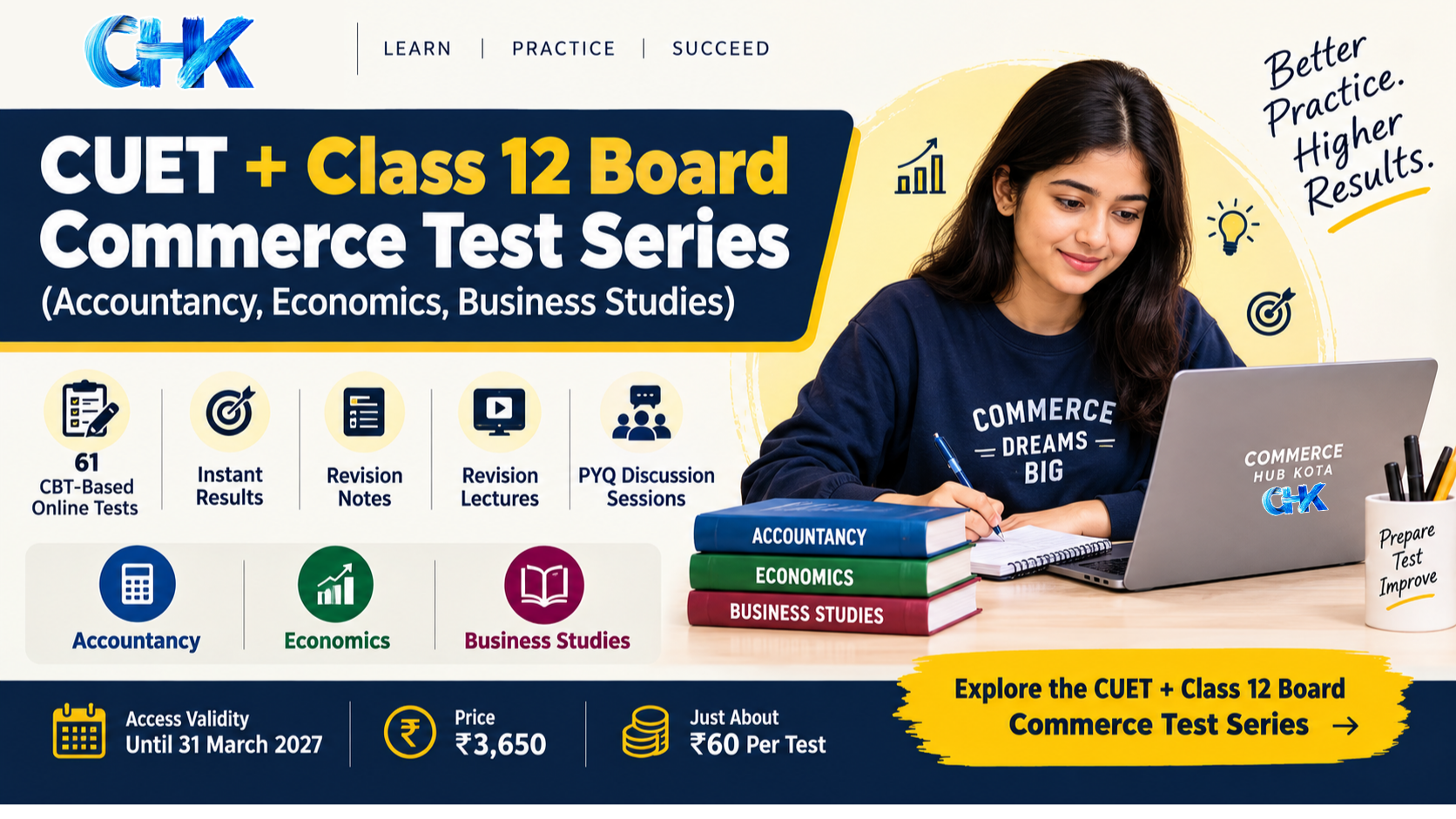
Commerce Hub Kota’s CUET + Class 12 Board Commerce Test Series is built around this idea. It includes 61 CBT-based online tests covering Accountancy, Economics and Business Studies, each followed by instant results, so students know exactly where they stand, see correct and incorrect answers, review their performance and identify areas requiring improvement. Access to the series remains valid until 31 March 2027.
Quick Overview of the Test Series
| Feature | Details |
|---|---|
| Test Series | CUET + Class 12 Board Commerce |
| Total Tests | 61 |
| Subjects | Accountancy, Economics & Business Studies |
| Mode | Online / CBT-based |
| Results | Instant |
| Access | Until 31 March 2027 |
| Price | ₹3,650 |
| Bonus Resources | Notes, Revision Lectures & PYQ Discussions |
Click here to join now
What Is the CUET + Class 12 Commerce Test Series?
At its core, this is a set of 61 online, CBT-based objective tests designed to support preparation for CUET Commerce and Class 12 Board exams together. Each test is taken online, follows an objective (MCQ-style) format, and gives students a result the moment they submit it.
The reason CUET and Board preparation are combined here is practical. A large part of the Commerce syllabus — the core concepts in Accountancy, Economics and Business Studies — overlaps between what a Board paper expects and what a CUET-style objective paper expects. The presentation of questions differs; the underlying concepts often don’t. A student who has genuinely understood a topic for Boards is usually in a reasonable position to attempt an MCQ on the same topic, provided they’ve had the chance to practise that format.
This test series is designed to give students exactly that — repeated, subject-wise practice, along with resources to revise and discuss questions afterward. It is a preparation tool created by Commerce Hub Kota and it is designed to support preparation for the exams.
What Do You Get for ₹3,650?
The ₹3,650 package is not just “61 tests.” It’s a combination of testing and revision support, built around a simple cycle: study, revise, test, and go back to what didn’t work.
61 CBT-Based Online Tests
The central component of the series is 61 online objective-type tests.
The tests cover:
Accountancy + Economics + Business Studies
With 61 tests available, students can spread their practice across their preparation period instead of trying to complete all their testing at the end.
Instant Results
There’s no waiting for a teacher to check your paper or for an answer key to be uploaded somewhere. The moment a test is submitted, the result is available. For a student trying to fit test practice around an already tight study schedule, this saves time and keeps the feedback loop tight — you attempt, you see the outcome, you move to correcting it, all in one sitting if needed.
Revision Notes
The included revision notes are meant for quick recall rather than first-time learning. They work best right before or right after a test — a fast pass over key points to refresh a topic before attempting questions on it, or a quick reference to check where a mistake came from.
Revision Lectures
The revision lectures reinforce concepts that students may have already studied but not fully retained. These are useful for topics where test performance shows a pattern of repeated errors — going back to a short lecture on that specific area is usually more efficient than re-reading an entire chapter.
PYQ Discussion Sessions
Previous-year questions show how examiners have actually framed questions on a topic in the past. Going through PYQ discussion sessions helps students get familiar with the pattern, the difficulty level and the type of application these questions typically demand, which is different from simply knowing the theory.
Subject-Wise Coverage
Accountancy
Accountancy is a subject where concepts build on each other — an error in understanding one head of accounts can affect how a student answers a completely different question later. Regular objective-question practice in Accountancy helps with three things specifically: recalling rules and formats quickly, applying them correctly to a given scenario, and noticing which specific areas keep tripping you up test after test, rather than assuming you’re “generally okay” with the subject.
Economics
Economics mixes conceptual understanding with a fair amount of terminology and some numerical application, depending on the topic. Repeated MCQ practice here matters because it’s easy to feel confident about a concept in theory and then get confused the moment it’s phrased differently in a question. Consistent revision alongside testing helps close that gap over time.
Business Studies
Business Studies often comes down to precise terminology and the ability to apply a concept to a short scenario or example. Objective testing is particularly useful here because it trains students to read a question carefully, identify what’s actually being asked, and pick the answer that fits the specific business situation described — not just the answer that sounds generally correct.
Click here to join now
CUET + Board Preparation: Why Testing Matters
There’s a natural sequence most students follow without thinking about it: Study → Revise. What often gets left out is: → Test → Analyse → Improve.
Reading and revising tell you what you’ve covered. They don’t tell you what you can actually recall under time pressure, apply correctly to a new question, or explain if asked a follow-up. That gap only becomes visible when you test yourself.
Structured testing, done consistently, helps with several things:
- Identifying weak areas before the actual exam does
- Improving speed by practising under a time constraint
- Getting comfortable with objective-style questions
- Improving accuracy through repeated attempts
- Tracking performance over time instead of guessing at it
- Building genuine exam confidence, not just a feeling of having “covered the syllabus”
- Making revision more targeted instead of re-reading everything equally
None of this guarantees a specific score, rank or selection — no test series reasonably can. What it does is give a more honest, ongoing picture of where a student’s preparation actually stands.
How to Use the 61 Tests Effectively
Sixty-one tests can be used well or wasted quickly, depending on how they’re approached. A simple sequence works better than attempting tests randomly:
Step 1: Study the concept
Go through the chapter or topic properly before attempting a related test — testing isn’t a substitute for first learning the material.
Step 2: Revise
Use the revision notes or a quick pass through your own notes to refresh what you just studied.
Step 3: Attempt the test
Take the relevant CBT-based test under exam-like conditions — no pausing midway to check the answer key.
Step 4: Analyse mistakes
Once results are in, go through every incorrect answer and understand why it was wrong, not just that it was wrong.
Step 5: Revise weak areas
Go back to the specific concept or chapter that caused the mistake — a revision lecture can help here.
Step 6: Retest
After some time, attempt a related test again to check whether the weak area has actually improved.
The score on any single test matters less than understanding the reason behind each wrong answer. A student who reviews mistakes carefully will improve faster than one who only tracks the number correct.
How the Instant Result System Helps
Getting a result the moment a test is submitted changes how useful that test actually is. A few specific benefits:
- Score awareness: You know immediately how the attempt went, without waiting days for feedback.
- Correct vs incorrect answers: Seeing exactly which questions were right or wrong makes it possible to review them while the reasoning is still fresh in your mind.
- Identifying weak areas: Patterns across several tests — the same type of question going wrong repeatedly — become easier to spot when results are available right away.
- Faster feedback loop: Less time between attempting and reviewing means less forgetting in between.
- Better revision decisions: Instant, specific feedback makes it easier to decide what to revise next, instead of revising everything equally out of uncertainty.
61 Tests for Long-Term Preparation
Access to the series is valid until 31 March 2027, which matters more than it might first appear. Sixty-one tests attempted all at once, in a short burst, won’t offer the same value as the same tests spread across a longer preparation timeline.
A more strategic approach could look like this:
- Initial concept practice — attempting tests soon after finishing a chapter, to check basic understanding
- Chapter or topic revision — using tests to revise specific chapters before moving ahead
- Mixed practice — attempting tests that combine topics, closer to how an actual exam mixes questions
- Exam-oriented practice — increasing the pace and treating tests like real exam conditions as exams approach
- Final revision — using the last set of tests, along with notes and PYQ sessions, in the weeks before the actual exam
Spacing tests out this way turns them into an ongoing preparation tool rather than a one-time practice exercise.
₹3,650: What Is Included?
| Included | Details |
|---|---|
| 61 Online Tests | CBT-based objective tests |
| Accountancy | ✓ |
| Economics | ✓ |
| Business Studies | ✓ |
| Instant Results | ✓ |
| Revision Notes | ✓ |
| Revision Lectures | ✓ |
| PYQ Discussion Sessions | ✓ |
| Access Validity | Until 31 March 2027 |
| Price | ₹3,650 |
Broken down simply, ₹3,650 for 61 tests works out to roughly ₹60 per test (₹3,650 ÷ 61 ≈ ₹59.84 per test), and that figure doesn’t even account for the revision notes, revision lectures and PYQ discussion sessions included alongside the tests.
61 Tests. One structured testing routine.
Who Should Consider This Test Series?
This test series may be a good fit for:
- Students preparing specifically for CUET Commerce
- Class 12 Commerce Board students
- Students preparing for both CUET and Boards at the same time
- Students who need regular, structured MCQ practice rather than occasional revision
- Students who want immediate results instead of waiting for manual checking
- Students who find it difficult to maintain a consistent testing routine on their own
It’s worth being clear about what this product is not. It is not a substitute for studying the syllabus in depth, understanding concepts properly, or following the official guidelines and pattern issued by CUET, CBSE or RBSE. It works best as a supplement to genuine study — a way to test and reinforce what’s already been learned.
Common Mistakes Students Make
- Studying without testing — assuming that reading a chapter thoroughly is enough preparation on its own.
- Attempting tests without analysing mistakes — taking a test, noting the score, and moving on without reviewing what went wrong.
- Focusing only on scores — treating the number as the goal, rather than treating it as information about where to improve.
- Ignoring weak chapters — repeatedly practising topics that are already strong while avoiding the ones that need work.
- Leaving MCQ practice until the last moment — trying to build objective-question speed and accuracy only in the final weeks before exams.
- Repeating the same mistakes — attempting new tests without revisiting the specific concepts that caused earlier errors.
- Not maintaining a revision cycle — treating study, revision and testing as separate, one-time activities instead of a repeating loop.
CUET + Boards — One Commerce Test Series
Preparing for CUET and Class 12 Boards separately often means duplicating effort — revising the same concept twice, in two different formats, without much coordination between the two. A combined test series lets students practise Accountancy, Economics and Business Studies once, in an objective format that’s relevant to both exams, rather than switching between two disconnected preparation tracks.
Related Resources
Class 12 Business Studies Notes
Frequently Asked Questions
1. What is the CUET + Class 12 Commerce Test Series? It is a test series by Commerce Hub Kota consisting of 61 CBT-based online tests in Accountancy, Economics and Business Studies, designed to support preparation for CUET and Class 12 Board exams.
2. How many tests are included? The series includes 61 CBT-based online tests in total.
3. Which subjects are covered? The test series covers three Commerce subjects: Accountancy, Economics and Business Studies.
4. Are the tests online? Yes, all 61 tests are online and CBT-based (computer-based, objective-type format).
5. Do students get instant results? Yes. Results, including score and a breakdown of correct and incorrect answers, are available immediately after submitting a test.
6. How long is access available? Access to the test series is valid until 31 March 2027.
7. What is the price of the test series? The complete test series is priced at ₹3,650.
8. Are revision notes included? Yes, revision notes are included as part of the ₹3,650 package.
9. Are revision lectures included? Yes, revision lectures are included alongside the tests.
10. Are PYQ discussion sessions included? Yes, PYQ (previous-year question) discussion sessions are included in the package.
11. Is this useful for students preparing for both CUET and Boards? Yes, the test series is designed specifically for students preparing for CUET Commerce, Class 12 Boards, or both at the same time.